Category Archives: Poetry Review

Review of a poetry collection by a woman writer.

Poetry Review: Prairie Bitch by Davi Nicoll

Cover of the 5.5 inch by 8.5 inch chapbook Prairie Bitch by Davi Nicoll. An off-white cover with drawn embroidered stitches of chains of small leaves, small stars, and other small flowers. Title and author's name look like hand embroidered.
Cover of chapbook Prairie Bitch by Davi Nicoll

Davi Nicoll is a Kansas kink poet. I encountered Nicoll at an open mic. Nicoll’s poems are firmly centered from a women’s gaze. Her poems explore sexuality and pleasure. Her poems also explore subversion, and submission, and trust within relationships. The poetry Nicoll writes speaks directly to women and feminine-presenting men who are taught starting in preschool to do what they must to keep the men they encounter in the grocery store, at church, at school, at the gas station, and in the workplace happy to protect themselves from physical harm. This protective state of mind is at the center of Nicoll’s chapbook Prairie Bitch.

Prairie Bitch explores how the title character lives as best they can in dead-end, working-class trending towards poverty Kansas. The character could live anywhere west of Topeka. They are doing the best they can in whatever job they can find. Nicoll uses a third-person omniscient voice to describe the character’s life. Mentally and spiritually the title character aims towards a life larger then what they are experiencing.

“Pr@irie bitch
uses @ libr@ry c@rd-drives
the speed limit-works
fine dining-e listens to NPR-…”

from Prairie Bitch by Davi Nicoll

The title character maintains their external shell because they are there for themselves, not the benefit the men around them. I assume, as a single woman in Kansas myself, the term “bitch” is a crown, coronet, or title adopted by the title character because that’s what the men in the place of employment, bar, or convenient store call them because the title character refuses to act obsequiousness towards anyone.

“Pr@irie bitch’
comes to the b@r
@lone, le@ves @lone-
usu@lly-drinks shitty beer
but not the shittiest beer
-cr@ves red wine & mezc@l-…”

from Prairie Bitch by Davi Nicoll

The title character chooses courage as they encounter and live through the drudgery of dead-end jobs and everyday violence and abuse. It would be easy for the title character to give up their ambitions and plans under the pressure of the constant physical and psychological headwind they experience. “Pr@irie bitch / bides her time.”

As an object, the Prairie Bitch chapbook is fun. Prairie Bitch is a hand produced chapbook. The cover’s printed design suggests free flowing hand embroidery. Hand embroidery of paper is common in the US Midwest as greeting or holiday cards and Christmas or Easter ornaments at local art and craft shows. The printed page is common copy paper. The printing has the look pages were spun out of a worn-out, black ink smearing mimeograph machine. I understand Davi Nicoll uses old typewriters to make her works. This makes the lettering and atmosphere of the print feel worn an guarded. The look of the print of the chapbook compliments the poetry. I like the feel Prairie Bitch is an art book. I look forward to seeing and hearing what Nicoll does next.

Follow Davi Nicoll, and purchase her chapbooks, on Instagram https://www.instagram.com/loadbearingdelusion/

Davi Nicoll was the featured poet at a Topeka, KS’ open mic Words in the Wind, July 2024 hosted by the Kansas Authors Club District 1 at Round Table Bookstore. Words in the Wind is held the fourth Wednesday of the month at Round Table Books in the North Topeka Arts District. Sign up to read starts at 6 PM and reading starts at 6:15. Poetry and prose are welcome. The Words in the Wind schedule and its featured writers are listed on the Kansas Authors Club District 1 Facebook wall, https://www.facebook.com/KACDistrict1

Poetry Review: changing with the tides by shelby leigh

Many poets in the past twenty years forgot, were never taught, or made no effort to study where and why Confessional Poetry originated. Craftmanship is thrown out the window because feelings are more important. Having the idea of a house will not build you a physical brick house, or even a house of straw. We need to first discuss the craft of carving a Confessional Poem out of life experiences before discussing shelby leigh’s poetry collection changing with the tides.

Let’s Talk About Confessional Poetry

Confessional Poetry gained notoriety in the late 1950s. Within Confessional Poetry, the poet explores the relationship between the writer and the experience of the “I”. You might think Confessional Poem’s writer is the “I”, but that is a fallacy.

The poet places the event and the I’s experience of the event one-step, or one degree outside themselves. The poet focuses on personal trauma, and through writing places the traumatic event outside themselves as they are, in that moment of writing, in a different physical location and not the same person. As a therapist-assisted practice, Confessional Poetry has documented positive outcomes.

Confessional Poetry from its very beginnings explored feelings of trauma, depression, and relationships with complete rejection of propriety. The Confessional Poem’s “I” is at the center of the poem. The poet rejects the use of metaphors for the experience, nor allows the speaker in the poem the peace of anonymity.

Early, award winning poets Anne Sexton (1928-1974) and Slyvia Plath (1932-1963) each used the Confessional form to process their life experiences. Both started writing at the recommendation of their therapists. Both attended lectures by Robert Lowell at Boston University. Lowell first used Confessional Poetry to explore his infidelity to his first wife. 

Early Confessional poets understood that while they were setting fire to1950s United States society’s sense of propriety, the poems required structure and respect for intonation, stress, syllables, and rhythm. The early poets, as part of their literary revolution, celebrated 1950s colloquial speech. Colloquial speech allowed everyone to know the “I’s” emotional state.

Besides using common language, other tools such as rhythm and sound expressed subtle to straightforward emotions. Pauses, filled pauses, and expressive nonwords such as grunts expressed the “I’s” emotion. Chunking, a phrase used as one word through lack of articulation or use of hyphen, for example Kansas City becomes Kans-City, emphasizes the “I’s” attitude.

Comprehending and producing differences in intonation, rhythm, and nonverbal clues can be hindered by physical brain damage and medically intentional chemical “numbing” or turning off certain parts of the brain. There is accumulating evidence hearing something read with feeling and expression, and when read silently but still with expression, increases comprehension of what is read. If one cannot feel, one cannot comprehend.

Let’s Talk About changing with the tides

The poetry collection changing with the tides is firmly set within the tradition of Confessional Poetry. The shape of the collection is a confessional journey stepping softly forward one poem at a time. With each poem the writer’s “I” progresses towards self-forgiveness.

The simple, concise language of the collection makes the healing story accessible to many people who otherwise would not pick up a book. Words mean what they mean. The “I” of the collection does not hide behind metaphors or extensive imagery to soften the self-blame and self-loathing expressed in the poems. I like the physicality of the descriptions, mostly monosyllable words, throughout the collection, for example “…i have so much to say,/ but i choke on/ self-doubt.”

What I do question is the use of the lower case i throughout the collection. Throughout my poetry life, as an undergraduate student to the present, I have been lectured that the use of the lower case i is a pulsating red flag of a person with seriously low self-esteem and in dire need of a good psychologist. If you are going to write yourself happy and healthy, use a capital I in reference to yourself. You are worthy of a capital I.

One of the problems with “radical responsibility”, as celebrated by many in the self-help industry and New Age thought crowd, is it gives systematic misogyny a pass when it puts the individual in an unsafe situation where they must guess which is the least lousy choice. The speaker in changing of the tides needs to learn the difference between taking responsibility and knowing when the “I” was keeping themselves safe in a dangerous situation.

changing with the tides is a poetry journey that will help those who are looking for confirmation there is a way forward to a better life. If someone picks up a pen to write their healing journey in poetry because of this collection, so much the better.

Please support your local library and check out this poetry collection, or support your local bookstore and its community by purchasing the collection from them.

shelby leigh’s website is shelbyleigh.co

changing with the tides (Gallery Books paperback 2022) front and back cover by Islam Farid

This Poem Guide on Anne Sexton by Austin Allen from 2015 is, I think, the best out there: https://www.poetryfoundation.org/articles/70275/anne-sexton-the-truth-the-dead-know

Poetry Review: Letters, To The Men I Have Loved (2014) by Mirtha Michelle Castro Mármol

“…who shall measure the heat and violence of a poet’s heart when caught and tangled in a woman’s body?” – from A Room of One’s Own (1929) by Virginia Woolf (1882-1941)

I am aware there is such a thing as narrative poetry, and I am not a fan of the narrative poetry form. However, who am I to say what a poetry form is? For example, what form defines a sonnet? Some 20th century sonnets are one letter per line so one word is spelled vertically. You know when you see it that the poem is a sonnet. Traditionalists will argue a sonnet must be iambic pentameter with exactly 14 lines ending with a heroic couplet. My “experimental” sonnets are not iambic but they do have 14 lines. Elizabeth Bishop’s posthumous published “Sonnet” (1979) is a reverse sonnet and is gorgeous. Back to narrative poetry, an essay can become a poem, maybe, while a poem can be an essay. Possibly the intended purpose of the poem or essay should dictate how it is pigeon-holed by its reader. But more often than not it is the form of the poem on the page that determines how it is perceived by the reader.

Letters, To The Men I Have Loved (2014) is a combination of letter/essays and poems written by Castro Mármol about and directed towards male family members and her former lovers. She admires and frets over her male relatives. She is very open with what happened between her and her lovers, and how that particular relationship ended messily. I have no idea how anyone can be that open about their relationships even when I, an absolute stranger, have no idea who these men are. I am originally from a small US Midwestern town where it is important to have everything about your life be private. There is a sharp divide between your public life and your private life. It is not about keeping secrets, but what happens between you and another person is not to be shared. So, reading about the relationships between Castro Mármol and her lovers was at first awkward. I can understand how this would be cathartic exercise and the artistic result is good. You don’t know anything about anything until you write about it. Some poets that I know would call the letter/essays poems in themselves, but I am not comfortable with that classification. The letter/essays convey something more than the poems. The letter/essays are better than the poems.

The poetry is the cathartic getting-over-the-relationship type that is universal among all humans even when they do not write poetry. The difference between the angst-wrung poetry most people write and throw in the trashcan and what Castro Mármol wrote is Castro Mármol’s poems are good. Some are breathtaking. If you have experienced a messy breakup, then you will empathize with her sentiments.

What I admire most about this collection is Castro Mármol writes as a woman and exclusively with a woman’s voice. The vast majority of Western women fiction, poets, and (especially) nonfiction writers write with a male slant even when the “voice” or “character” of the piece is female. I would argue it is an unconscious habit learned from equally unaware teachers. Historically a woman had to write, or imitate a “male” voice if she wanted a passing grade, to obtain a graduate degree, or to have her writing published. In A Room of One’s Own (1929) by Virginia Woolf, Woolf discusses the necessity of a woman writing as a woman to be a complete human being and how, at the time she gave the lecture to a group of British, upper to middle class, women university students in 1928, writing as a woman was a precarious activity. Finding this collection by a woman poet writing as a woman on a national chain bookstore shelf as a new book makes me feel better about the world. I look forward to seeing what Castro Mármol does next.

Letters, To Men I Have Loved (ISBN: 978-1-4787-3590-8) can be found at bookstores, online through your favorite bookseller, and at your friendly public library. It was illustrated by Deanna First.

Castro Mármol’s website can be found at http://mirthamichelle.com/ .

The publisher Outskirts Press (http://www.outskirtspress.com) is a self-publishing company. The poetry and letter/essay collection can be ordered online at http://outskirtspress.com/mirthamichelle/ .


A discussion (2000) on Elizabeth Bishop’s poem “Sonnet” in The Atlantic. “Sonnet” was first published in 1979 three weeks after Bishop’s death. http://www.theatlantic.com/past/docs/unbound/poetry/soundings/bishop.htm

Quotes from Woolf’s A Room of One’s Own (1929) via GoodReads.  http://www.goodreads.com/work/quotes/1315615-a-room-of-one-s-own

Poetry Review: She of the Dreaming Sky (2005) by Diane C. Randall

reviewcover (480x640)

“She of the Dreaming Sky” (2005) took time to assimilate. Randall describes her poetry as “spiritual poetry” and that is true. The challenge when reading “spiritual poetry” is not to be intimidated or put off by the intimacy expressed by the poet. A spiritual expression, in my mind, is an effort to get at as direct as possible the point of entry where the artist makes first contact with the word, music, image, motion, or other creative endeavor without judgement as it enters his or her conscious awareness. Anyone who can do this well for an entire poetry collection is to be commended.

Western European art and poetry often desire to use the entire planet’s cultural treasure chest in its creative expression. Randall uses the entire North American cultural palette with a deft hand. Some individuals may find reflections of their own insecurities in her poetry, and criticize her for that perceived appropriation. My response to such complaints is two questions: Who are you to order the structure of image or sound or voice of the interaction of a soul and spirit at point of contact? What are you projecting onto what is in front of you?

The poems within “She of the Dreaming Sky” took time to unwrap. I selected it from the bookstore shelf because it was the first woman-authored poetry collection I pulled from the shelf. First read-through I was disappointed. The poems felt cliché and, as someone who has over the years hung out with Tai Chi practitioners and aging hippies, tired. Then, I would read a line or phrase whose clarity stunned me.

Reading the poems in “She of the Dreaming Sky” is like watching an autumn cloudy sky being cleared of gray clouds by a brisk north wind. The clouds are moving, going somewhere, and a patch of painfully blue sky appears above you. The brilliant blue sky is there existing behind the clouds all the time. You as reader must have patience to wait for the clouds to clear. One after another the poems became clear – or I became clear – with the passage of time.

The book comes with a compact disc sound recording of eight poems from “She of the Dreaming Sky” read with music in the background. This is a good multi-media presentation of the work. Artwork throughout the collection is by Randall. It all looks and sounds good.

“She of the Dreaming Sky” made me cognizant of what I project onto the world. I had to work for that realization, and to appreciate the quality of these poems. This collection contains many more good to excellent poems than okay to “meh” poems that you see in other collections identifying themselves as “spiritual poetry”. It is easy for “spiritual poetry” to be cloyingly grocery store cake frosting sweet, extremely earnest, and downright icky in my opinion. Randall avoids those pitfalls by crafting her poems to get to as close as she can to that point of contact between the subconscious and that part of her that devises words.

I have not located a website for either Diane C. Randall or her publisher Pearl’s Book ‘em Publisher. “She of the Dreaming Sky” is available on online and through your favorite local bookstore or library.

If you are interested in “spiritual jazz” I would recommend Raven Wolf C. Felton Jennings II. He creates spiritual jazz of the St. Louis tradition and is phenomenal. Pug Dog Records is his own label. As Raven Wolf says, “Change your music, change your life”.    http://www.pugdogrecords.com/node/9

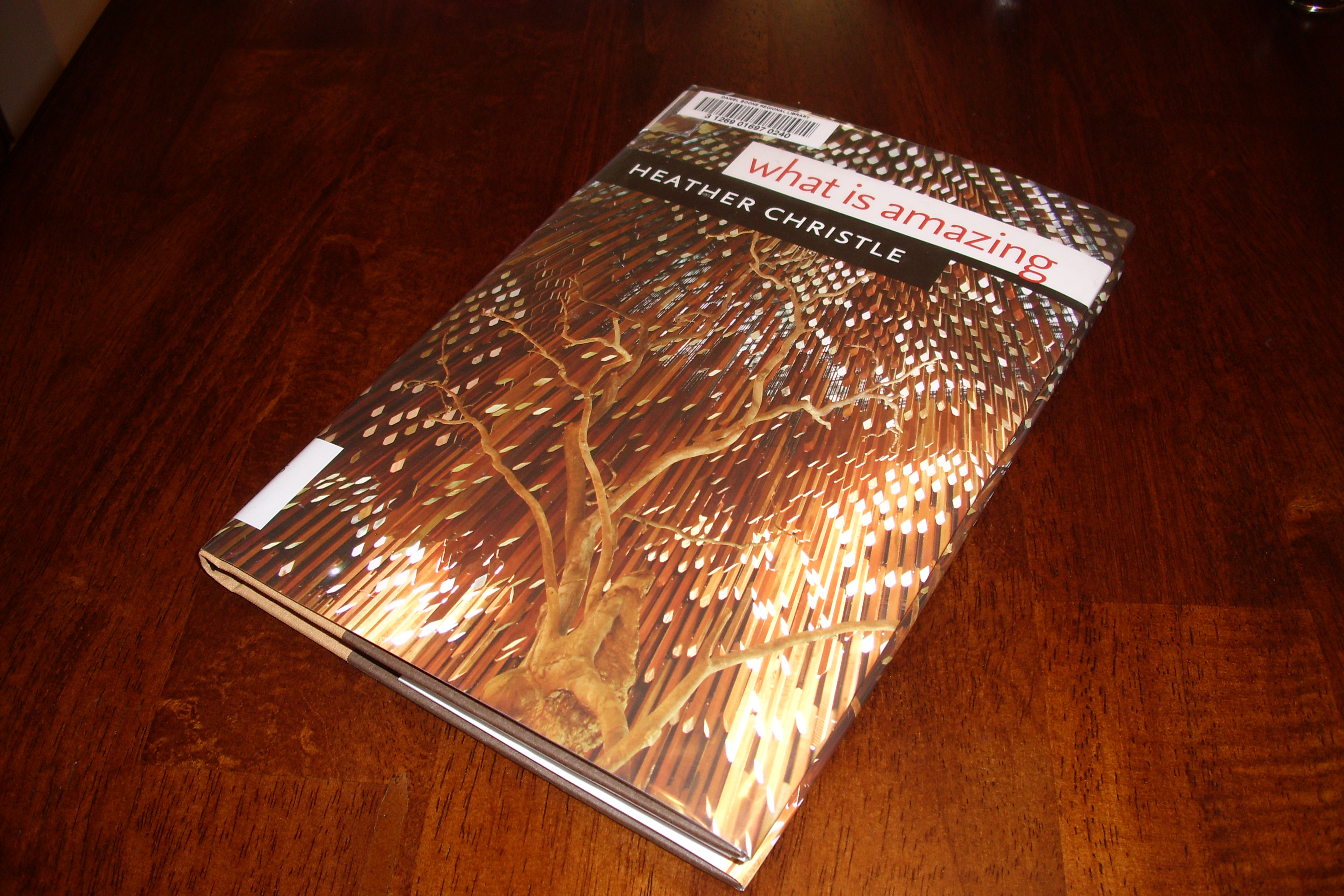
Poetry Review: what is amazing by Heather Christle

The cover of what is amazing by Heather Christle

The cover of what is amazing by Heather Christle

I first read what is amazing by Heather Christle at 2:30 in the morning when I could not sleep. I thought I would start by reading the first two or three poems then read something less interesting until I felt sleepy. I read the book all the way through in one sitting. My initial response was a combination of “you cannot be serious” and “oh, that’s good”.

what is amazing is a challenge if you are looking to enjoy and read traditional poetry. I enjoy well-done experimental, modern poetry as well as a well-crafted sonnet. I heard the echoes of Walt Whitman (compare “Oh, Captain, My Captain” to its antithesis Christle’s “The Seaside!”), Emily Dickinson  and William Carlos Williams. I am not sure that is a good thing to hear such loud echoes of other poets in published poems. It is not the same thing to drag the ghosts of great poets into your work as to point at a particular poem and say, “It is like that.”  The challenge is to craft your truth as reflected in a William Carlos Williams poem. Christle expresses her truth, a very 21st-century truth, in the poetry presented in what is amazing.

The collection is divided into three sections. The rationale is not obvious. You have to sit and think about the poems as a group which is probably the best way to approach what is amazing.

The poems in this collection are tasked to generate feelings, empathy within the reader. The reader is vital to Christle’s poems. The poems are not a voice speaking, telling you what to think, but an invocation of an emotional response within the reader.

The collection starts out with “The Seaside!” letting the reader know this is not a book of traditional poetry. My favorite poems are found in the middle section of the book. The middle section poems have clearer, tighter imagery. “Spider” is my favorite poem in the collection. The imagery of “Difficulties” and several other poems throughout, such as “If You Go into the Woods You Will Find it has a Technology”, reminded me of Flatland: A Romance of Many Dimensions (1884) by E.A. Abbott. “Basic” is an amusing poem invoking the computer programming language BASIC. Modern subjects and images are used as the voice and objects interact and attempt to generate an emotion in the reader. These are not easy poems. I think the reliance on imagery and the reader’s response to the imagery makes most of the poems ineffective when read aloud.

After sitting with what is amazing for several weeks I still have the alternating responses of “that does not work” and “very good”. Some things work in this collection, and some attempts are not successful. I will read along and stumble over a couplet that is like Emily Dickinson and that bothers me. I would recommend what is amazing as a solid introduction to what will be 21st-century poetry. What is a unique 21st century emotion or sensibility? I have not figured that out, yet, and Christle is working on it, too.

By Heather Christle, what is amazing (2012), Wesleyan University Press. ISBN: 9780-8195-7217-6.

http://www.wesleyan.edu/wespress

Poetry Review: Silver Roses: Poems by Rachel Wetzsteon

Silver Roses: Poems (2010) by Rachel Wetzsteon, Persea Books, Inc.

I completely enjoyed this collection. It was like having an intelligent conversation with a complete stranger and there was nothing awkward about it.

Even though the collection’s three sections are united in theme, I will refer to several poems in chronological order. The opening poem “Among the Neutrals” sets Wetzsteon’s exploratory flag solidly in the ground to say: Decide, refuse ambivalence and a world of “maybe”. This is an interesting way to start this collection, in the scheme of things. I would like to why this selection was made.

The second poem, “Freely from Wyatt” is my second favorite poem. There was an immediate emotional response. Stanza i. While I do not understand the purpose of biscotti in the culinary world, I understand Wetzsteon’s sentiment. Homemade apple dumplings work just as well. Stanza ii. Yes, exactly! Stanza iii. Yes, exactly! You are welcome here.

“An Actress Prepares” touches upon something I wonder about when reading contemporary poetry. I flow with the poem until she gets half way through and the voice of the actress states: “Vote me off the island.” Will anyone in twenty years understand what “Vote me off the island” means? It is like watching an early 19th century English Regency costume drama/film and, in one domestic scene, there is a US Civil War quilt pattern on a bed. The vast majority of people would not notice such a pathetic detail, but I do. It’s like hitting a deep pot hole in the road. It threw me out of the suspension of reality. That said, I understand no one drives a horse drawn wagon through the woods on snowy nights these days (apologies to Robert Frost) as I as a reader “get” the emotional and physical sensation of the frigid isolation and impatient pull of the voice’s horse. This is not a criticism against Wetzsteon, just a question for the universe in general.

Many of the poems in the first two sections are what I would call writing exercise poems. Writers, after all, write and are passionate to the point of obsessive about their craft if they are to be any good. I found it odd to find them in a collection but they are quite well done. They are enjoyable and I would guess that Wetzsteon had fun doing them. Maybe that’s where the brightness of the first two sections originates.

The final section “The Tennis Courts At Stuyvesant Town” has a definite darkness to it. Wetzsteon is emotionally working through things, or at least attempting to, and not getting to the other side.

The final poem of the collection, “Silver Roses”, I was surprised to recognize as having read before. For whatever reason I thought it had been in “The New Yorker” but it wasn’t until after reading the bibliography at the end, I realized I had read the poem “Silver Roses” in an issue of October, 2010 “Poetry” which I had purchased. This poem at first read first stuck with me like fuzzy weed seeds stick to your socks. You cannot wash them off and must pick them off the sock cuffs. I knew what the voice was saying. It was the shared emotional feeling I have with my dad over a film or concert, the feeling of leaving a concert (here opera) and taking the desire for that reality into the street and walking to the car and driving home with a nocturne feeling of a magical night. It is that joyful, floating feeling you have in spite of yourself.

I did not read Wetzsteon’s biography and Grace Schulman’s Introduction until I had read the collection through twice. It came as a shock this was a posthumous collection.

I cannot imagine I am the first to make this sort of an analogy: It was like you are at a dinner party and the dishes are in the dish washer or sink and everyone is sitting back and drinking wine and talking, laughing and you have discovered a wine someone picked-up on their international travels which you really like (and you don’t really like wine) and the host (God, bless him) is staring at the empty wine bottle and you are tipsy and a little impertinent and you sit there with your empty glass and demand: “What do you mean there is no more of this wine?”

Silver Roses: Poems by Rachel Wetzsteon (1967-2009)

ISBN: 978-0-89255-364-8

http://www.perseabooks.com

Poetry Collection Review: The Alchemist’s Kitchen (2010) by Susan Rich

The Alchemist’s Kitchen (2010) by Susan Rich published by White Pine Press

I really wanted to like the first poetry collection I reviewed. I wanted to admire the collection as a whole with individual poems synthesizing into a well-rounded exploration of some grand idea. I did not desire to find myself disappointed.

When I plucked The Alchemist’s Kitchen from the 811 section of the “New Book” shelves of the public library, I had every expectation of liking the book. I went home, sat down and read straight through over 4 or 5 days. I admired the title and the concepts stated in the three sections of the book and looked forward to seeing how the poet explored and expanded the concept of an alchemist’s kitchen.

Alchemy is the art and science of taking basic, gross, undesirable material (example: lead) and processing it into a more valued, possibly “purer” substance (example: gold). Alchemy as a concept is used in industrial processing and in writing fiction: take society’s trash and transform it into “gold”.  The Alchemist’s Kitchen has the structure to accomplish showing the process of transforming emotional trash into jewels but does not produce.

Disappointed, I sat the book down beside my reading chair. For several days I scowled at it. I moved it from the kitchen table to the ottoman several times. Then, I picked up the collection and read several random poems.

Over the next couple of weeks, I read one or two poems before leaving for work in the morning, while supper cooked, or before going to bed a night. I slowly fell in love with the poems as individuals. I feel like I went to class with the girl who wanted to disappear and stepped in front of a truck. I can see Mrs. Myra Albert Wiggins mounting photographs in his shop. I know his smile as he watches his wife ride her bicycle down the street or when the playboys make snide remarks about his clothes. I feel sorrow for the refugee girl whose hand was cut off by a African bandit who thought her plastic, shiny, gold-colored bracelet had monetary value.

Here lies the problem with The Alchemist’s Kitchen. What Rich has is several poetry collections scattered throughout one book. There is more than one, independent, incomplete story told in this collection. If Rich was attempting to show that the multiple stories (for example, the plight of refugees all over the globe, the legacy of Mrs. and Mr. Myra Albert Wiggins) come to the same alchemical end, she does not accomplish that. I want to know more about Mrs. And Mr. Myra Albert Wiggins. I want to watch the story of the refugees from beginning to end. Some of these poems are beautiful, but as a whole the collection is not cohesive. If she could explore one story, the potential impact of that collection could be earth-shaking.

Publisher: White Pine Press (www.whitepine.org)

ISBN: 978-1-935210-14-6