Poetry Review: Prairie Bitch by Davi Nicoll

Cover of the 5.5 inch by 8.5 inch chapbook Prairie Bitch by Davi Nicoll. An off-white cover with drawn embroidered stitches of chains of small leaves, small stars, and other small flowers. Title and author's name look like hand embroidered.
Cover of chapbook Prairie Bitch by Davi Nicoll

Davi Nicoll is a Kansas kink poet. I encountered Nicoll at an open mic. Nicoll’s poems are firmly centered from a women’s gaze. Her poems explore sexuality and pleasure. Her poems also explore subversion, and submission, and trust within relationships. The poetry Nicoll writes speaks directly to women and feminine-presenting men who are taught starting in preschool to do what they must to keep the men they encounter in the grocery store, at church, at school, at the gas station, and in the workplace happy to protect themselves from physical harm. This protective state of mind is at the center of Nicoll’s chapbook Prairie Bitch.

Prairie Bitch explores how the title character lives as best they can in dead-end, working-class trending towards poverty Kansas. The character could live anywhere west of Topeka. They are doing the best they can in whatever job they can find. Nicoll uses a third-person omniscient voice to describe the character’s life. Mentally and spiritually the title character aims towards a life larger then what they are experiencing.

“Pr@irie bitch
uses @ libr@ry c@rd-drives
the speed limit-works
fine dining-e listens to NPR-…”

from Prairie Bitch by Davi Nicoll

The title character maintains their external shell because they are there for themselves, not the benefit the men around them. I assume, as a single woman in Kansas myself, the term “bitch” is a crown, coronet, or title adopted by the title character because that’s what the men in the place of employment, bar, or convenient store call them because the title character refuses to act obsequiousness towards anyone.

“Pr@irie bitch’
comes to the b@r
@lone, le@ves @lone-
usu@lly-drinks shitty beer
but not the shittiest beer
-cr@ves red wine & mezc@l-…”

from Prairie Bitch by Davi Nicoll

The title character chooses courage as they encounter and live through the drudgery of dead-end jobs and everyday violence and abuse. It would be easy for the title character to give up their ambitions and plans under the pressure of the constant physical and psychological headwind they experience. “Pr@irie bitch / bides her time.”

As an object, the Prairie Bitch chapbook is fun. Prairie Bitch is a hand produced chapbook. The cover’s printed design suggests free flowing hand embroidery. Hand embroidery of paper is common in the US Midwest as greeting or holiday cards and Christmas or Easter ornaments at local art and craft shows. The printed page is common copy paper. The printing has the look pages were spun out of a worn-out, black ink smearing mimeograph machine. I understand Davi Nicoll uses old typewriters to make her works. This makes the lettering and atmosphere of the print feel worn an guarded. The look of the print of the chapbook compliments the poetry. I like the feel Prairie Bitch is an art book. I look forward to seeing and hearing what Nicoll does next.

Follow Davi Nicoll, and purchase her chapbooks, on Instagram https://www.instagram.com/loadbearingdelusion/

Davi Nicoll was the featured poet at a Topeka, KS’ open mic Words in the Wind, July 2024 hosted by the Kansas Authors Club District 1 at Round Table Bookstore. Words in the Wind is held the fourth Wednesday of the month at Round Table Books in the North Topeka Arts District. Sign up to read starts at 6 PM and reading starts at 6:15. Poetry and prose are welcome. The Words in the Wind schedule and its featured writers are listed on the Kansas Authors Club District 1 Facebook wall, https://www.facebook.com/KACDistrict1

Recipe Review: Jeremiah Tower’s Lobster Sandwich in Food & Wine, August 2024

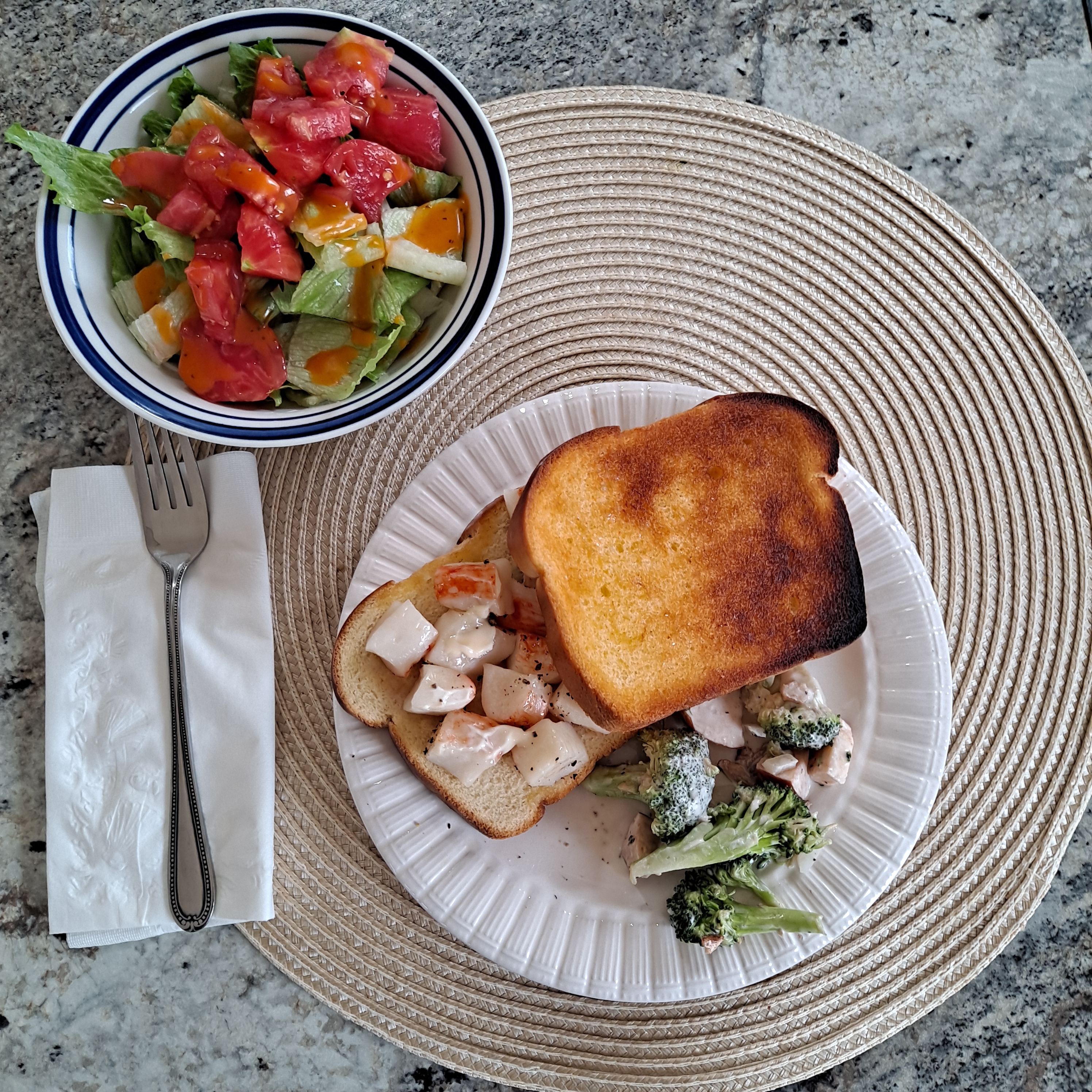
On a white ceramic plate a sandwich made of toasted on one side, soft on the other white bread with broiled imitation lobster or pollock sprinkled with black pepper sits beside a raw broccoli, apple, and walnut salad. To the left  and above the plate is a salad bowel with a lettuce and garden fresh chopped tomato drizzled with Dorthey Lynch dressing. To the left of the plate but below the salad bowel is a silver fork resting on a white paper napkin. All of the above rests on a round, thin, braided straw placemat.
Jeremiah Tower’s Lobster Sandwich using Imitation Lobster served with a broccoli-apple salad and a lettuce and tomato salad.


I stopped by the small-town Kansas Apple Market grocery store for a handful of items I would need for my lunches the coming week. I had read through earlier in the weekend the August 2024 issue of Food & Wine. I appreciated the simplicity of Jeremiah Tower’s Lobster Sandwich recipe featured at the end of the magazine in Andree Gosnell’s Lobster Sandwich article. Alas, lobster is not within my food budget. While I admired the Apple Market’s selection of Kansas’ own Fanestil Meats, I was thrilled to see packages of a west coast company’s Imitation Lobster beside the various packages of Imitation Crab. Imitation Lobster was well within my budget. I bought two.

I know Imitation Lobster is pollock. I read the ingredient list in the store. The back of the package read that less than 2% of the packaged fish is lobster. I am perfectly content, and greatly amused, to think that somewhere in a fish processing facility there is a faded picture of a lobster hanging crookedly in a dimly lit hallway which justifies the “Imitation Lobster” label. My science Ph.D. degree also tells me less than 2% is not statistically significant if we use the p-value of 0.01 instead of the standard p-value of 0.05.

Imitation Crab, and Imitation Lobster, also known as pollock, provide an important source of animal protein for budget-sensitive families and fixed-income people. Pollock as Imitation Crab can be sliced into noodles and added to spaghetti and cheese meals. The processed fish can chopped, mixed with diced and cooked onion, carrots, potatoes, and cream cheese, with 2 tablespoons of the mixture rolled inside 8-inch tortillas, then covered with green or red enchilada sauce. Pollock is a chameleon ingredient that can be whatever you want it to be.

For a no-coast version of Jeremiah Tower’s Lobster Sandwich, the first thing you need to do is go out to the garden or patio and pick the best tomato. Certain tomatoes are slicing tomatoes. Some are cooking tomatoes. You will know the difference. The tomato will be warm from the sun and afternoon heat. The red fruit will glow and feel heavy in the palm of your hand.

Once back in the kitchen, start the oven broiler. While the broiler heats, prepare the fish. Fold and shape aluminum foil into a shallow dish. Drizzle and smear olive oil over the bottom of your aluminum foil dish. Measure out a half-cup of fish, by weight or volume, for each sandwich. Drizzle lemon juice over the Imitation Lobster. Set the fish aside.

Soften 1 tablespoon unsalted butter per sandwich in the microwave. Spread the softened butter over two slices of Sara Lee’s Hawaiian Bread. Sara Lee’s Hawaiian Bread is not a bread I see every time I go to the grocery store. It freezes well so I always buy an extra loaf. It may be easier to spread butter on frozen bread. Sara Lee’s Hawaiian Bread is very soft, probably because of the potato flakes in the ingredient list.

Place the fish and butter-side-up bread under the oven’s broiler. You will need to watch the bread to prevent scorching. The fish will take longer to turn golden brown.

Once the toasted bread has cooled enough to touch, spread mayonnaise on the bread’s soft, untoasted side. I prefer to use homemade eggless mayonnaise for summer sandwiches. However, the recipe-suggested Hellmann’s mayonnaise is good, too. Because I have no idea where to obtain fresh chervil in rural Kansas, I used fresh parsley from my garden. I have added chervil to my December seed catalog list. The only way I can obtain many herbs used in finer recipe magazines like Food & Wine is to grow them myself.

Build the sandwich with the warm Imitation Lobster on the soft side of a toasted bread slice. Sprinkle chopped parsley, a pinch of salt and a couple of twists of fresh ground black pepper over the fish. You could combine the Imitation Lobster, mayonnaise, salt, pepper, herbs, and a squeeze of lemon juice in a bowl, but then you have another bowl to wash.

I also dislike soggy bread caused by juicy tomato slices. A firmer bread toasted dry to absorb the tomato juice better serves well for a bacon, lettuce, and tomato sandwich. A seafood salad-type sandwich is best served on a sweeter, soft bread. The tomato slices can go on the side, or on a lettuce salad.

The sandwich goes well with a salad of lettuce and chopped, sun-warm tomato. Drizzle Dorothy Lynch homestyle dressing over the lettuce and tomatoes for a true no-coast, US Midwestern salad experience.

Jeremiah Tower’s Lobster Sandwich provides a good foundation for a seafood salad-type sandwich. I have used broiled shrimp in place of Imitation Lobster or Crab. I have also used baked catfish and breaded catfish. Baked cod is best served alongside sweet corn-hominy cream soup. Beer-battered cod needs a simple tartar sauce. The Lobster Sandwich recipe contains so much potential. Your imagination is your only limiting factor.  

Recipe is here (I last visited the link 10/14/2024): https://www.foodandwine.com/jeremiah-towers-lobster-sandwich-8687394

Poetry Review: changing with the tides by shelby leigh

Many poets in the past twenty years forgot, were never taught, or made no effort to study where and why Confessional Poetry originated. Craftmanship is thrown out the window because feelings are more important. Having the idea of a house will not build you a physical brick house, or even a house of straw. We need to first discuss the craft of carving a Confessional Poem out of life experiences before discussing shelby leigh’s poetry collection changing with the tides.

Let’s Talk About Confessional Poetry

Confessional Poetry gained notoriety in the late 1950s. Within Confessional Poetry, the poet explores the relationship between the writer and the experience of the “I”. You might think Confessional Poem’s writer is the “I”, but that is a fallacy.

The poet places the event and the I’s experience of the event one-step, or one degree outside themselves. The poet focuses on personal trauma, and through writing places the traumatic event outside themselves as they are, in that moment of writing, in a different physical location and not the same person. As a therapist-assisted practice, Confessional Poetry has documented positive outcomes.

Confessional Poetry from its very beginnings explored feelings of trauma, depression, and relationships with complete rejection of propriety. The Confessional Poem’s “I” is at the center of the poem. The poet rejects the use of metaphors for the experience, nor allows the speaker in the poem the peace of anonymity.

Early, award winning poets Anne Sexton (1928-1974) and Slyvia Plath (1932-1963) each used the Confessional form to process their life experiences. Both started writing at the recommendation of their therapists. Both attended lectures by Robert Lowell at Boston University. Lowell first used Confessional Poetry to explore his infidelity to his first wife. 

Early Confessional poets understood that while they were setting fire to1950s United States society’s sense of propriety, the poems required structure and respect for intonation, stress, syllables, and rhythm. The early poets, as part of their literary revolution, celebrated 1950s colloquial speech. Colloquial speech allowed everyone to know the “I’s” emotional state.

Besides using common language, other tools such as rhythm and sound expressed subtle to straightforward emotions. Pauses, filled pauses, and expressive nonwords such as grunts expressed the “I’s” emotion. Chunking, a phrase used as one word through lack of articulation or use of hyphen, for example Kansas City becomes Kans-City, emphasizes the “I’s” attitude.

Comprehending and producing differences in intonation, rhythm, and nonverbal clues can be hindered by physical brain damage and medically intentional chemical “numbing” or turning off certain parts of the brain. There is accumulating evidence hearing something read with feeling and expression, and when read silently but still with expression, increases comprehension of what is read. If one cannot feel, one cannot comprehend.

Let’s Talk About changing with the tides

The poetry collection changing with the tides is firmly set within the tradition of Confessional Poetry. The shape of the collection is a confessional journey stepping softly forward one poem at a time. With each poem the writer’s “I” progresses towards self-forgiveness.

The simple, concise language of the collection makes the healing story accessible to many people who otherwise would not pick up a book. Words mean what they mean. The “I” of the collection does not hide behind metaphors or extensive imagery to soften the self-blame and self-loathing expressed in the poems. I like the physicality of the descriptions, mostly monosyllable words, throughout the collection, for example “…i have so much to say,/ but i choke on/ self-doubt.”

What I do question is the use of the lower case i throughout the collection. Throughout my poetry life, as an undergraduate student to the present, I have been lectured that the use of the lower case i is a pulsating red flag of a person with seriously low self-esteem and in dire need of a good psychologist. If you are going to write yourself happy and healthy, use a capital I in reference to yourself. You are worthy of a capital I.

One of the problems with “radical responsibility”, as celebrated by many in the self-help industry and New Age thought crowd, is it gives systematic misogyny a pass when it puts the individual in an unsafe situation where they must guess which is the least lousy choice. The speaker in changing of the tides needs to learn the difference between taking responsibility and knowing when the “I” was keeping themselves safe in a dangerous situation.

changing with the tides is a poetry journey that will help those who are looking for confirmation there is a way forward to a better life. If someone picks up a pen to write their healing journey in poetry because of this collection, so much the better.

Please support your local library and check out this poetry collection, or support your local bookstore and its community by purchasing the collection from them.

shelby leigh’s website is shelbyleigh.co

changing with the tides (Gallery Books paperback 2022) front and back cover by Islam Farid

This Poem Guide on Anne Sexton by Austin Allen from 2015 is, I think, the best out there: https://www.poetryfoundation.org/articles/70275/anne-sexton-the-truth-the-dead-know

Review: Dr. Kristi Baker-Lampe, Music for a Sunday Afternoon

One forgets world-class talent can be found in everyday spaces like public libraries on a Sunday afternoon. The Topeka & Shawnee County, KS Public Library for 50 years has presented Music for a Sunday Afternoon. The 2023 summer series opened on June 4 with Dr. Kristi Baker-Lampe’s piano recital. I went to the library expecting a summer music program in an air-conditioned space, I brought a much-needed cardigan, and was pleased with Baker-Lampe’s program.

Baker-Lampe is a natural educator. Delightfully, she spoke of the history of a piano piece and its composer before playing. Even if this information was known, the historical notes brought the collection of songs she presented into context. Baker-Lampe presented, with a light hand, a recital of Continental Spanish and Modern South American piano pieces, with pieces by Johannes Brahms and Frederic Chopin, respectively, as bookends.

The recital hosted the North American premier of Sergio Rene Martinez’s Sonate No. 5 “Tetrology of Nature”. In order of presentation, she performed Dominico Scarlatti’s Sonata K. 105/L. 204, then Antonio Soler’s Sonata R. 21, then Martinez’s Sonate No. 5. Martinez’s early 21st century South American sounding Sonate No. 5 stood shoulder to shoulder with the selected works of the two 18th century master composers.

Before performing the Sonate No. 5, Baker-Lampe explained Martinez strove to provide a musical impression of the natural world as it is now. Martinez also offers commentary on the ongoing ecological degradation of the South American ecosystems. Martinez successfully provides four distinct, auditory, panoramic snapshots in the tradition of Modest Mussorgsky’s 1874 piano suite Pictures at an Exhibition, which was later adapted for orchestra in 1922 by Maurice Ravel.

The first movement, “Minerals Notes” invoked the cold taste of rock and minerals of water from a Rocky Mountain spring located above the tree line that shoots like a fountain out of a crack in a cliff face. The opening comments by Baker-Lampe implied the intention of the first movement was to invoke the feeling of being immersed in a cave ecosystem. The sense of rocks, minerals, and water is within the first movement.

The concluding fourth movement was my favorite. If you have walked or rode a bicycle along a park pathway, foot, or animal trail that followed a stream, and listened to an intermittent stream flow over the stones, gravel, and through pools, you will know the theme of Martinez Sonate No. 5’s fourth movement.

The movement invokes the spirit of an evaporating stream. Intermittent by definition is a water body that does demonstrate constant flow year-round. In Northeast Kansas, certain named creeks and streams historically flowed year-round. With groundwater, spring, and surface water overuse, abuse, and a changing climate moving long-term, low rain contour lines, called isohyets, eastward, creeks and streams can now be classified as intermittent, and are without environmental protections.

The sound and sense of the water disappearing and appearing as it flows through the gravel and sand into an open space above bedrock and the water table is in the sound of the fourth movement. Martinez, through Baker-Lampe’s interpretation, invokes the beauty of the natural world. May what we the listeners do with this inspiration improve the world at least one small, patient, loving act at a time.

Did you know Chopin wrote a bolero? I did not know Chopin wrote a bolero. Chopin’s Bolero Op. 19 is rarely performed in the United States. Music purists can squabble over whether Chopin’s Bolero is a bolero, or a polonaise all they want. If Chopin calls the piece a bolero, I will honor his choice and call it a bolero.

Ending the recital with Chopin’s Bolero Op. 19 was a wise decision. Baker-Lampe’s internal musicality and deftness at the piano keyboard shined in her performance. Chopin is not for the faint at heart.  Baker-Lampe hit the light notes of the piece, keeping the bolero fun and well balanced. The music selection and performance were enjoyable. Baker-Lampe provided thoughtful introduction and interpretation to each work. It was a satisfying way to spend part of a summer Sunday afternoon.

The next Music for a Sunday Afternoon is August 13, 2023. The Topeka Jazz Workshop is scheduled to perform 3 to 5 pm.

Check out the Topeka & Shawnee County Library for more music and Summer Reading programming.

Novelette Review: The Only Harmless Great Thing (2018) by Brooke Bolander

TheOnlyHarmlessGreatThing


You really need to read this novelette.

A novelette is a story with less than 20,000 words. The Only Harmless Great Thing (2018) is 17,200 words long. A novella is a written work with between 20,000 and 40,000 words, or less than 100 pages long. It is longer than a short story or novelette, which has less than 20,000 words, but not as long as an 80,000-word novel. The exact length of a novelette or novella is defined by periodical, publisher, and award  guidelines. Historically, a novella was intended to educate the reader, moralize a social problem, or point out a satirical-worthy absurdity. With a novella’s less than 40,000-word length, a story can have multiple characters or concentrate on the journey of a single character. Short fiction, less than 40,000 words, works best when the story focuses on a character or characters’ emotional and personal development, and does not tackle a large-scale issue. The best novellas and novelettes have the character development of a novel with the fast pace of a short story.

The Only Harmless Great Thing (2018) by Brooke Bolander is a novelette of such power and beauty, you should be a changed person after reading it. In less than 20,000 words Bolander rips out your heart, makes your jaw hurt, punches you in the gut, and in the end sob at the horror and beauty at the end of everything.

If you are looking for a linear plot, item A -> item B -> item C ->, you will be very disappointed. Bolander moves among the multiple stories happening years, and millennia, apart, to come to the center story’s ending. The stories of our lives are not linear. What happened 20 years ago informs, and can dictate, the choice we make in the now.

This is a story of stories. The novelette starts in the far future where all that is left of humanity is the story elephants’ Many Mothers carry among themselves of why they glow in the dark. All the stories the future elephants would tell are stories you read in the novelette. One story line is how the mythic female elephant Furmother-With-The-Cracked-Tusk, who had fur like a bear, rescued and released all stories into the world. In another story line Topsy the elephant and the stubborn, dying, Radium Girl named Regan originally from coal mine country tell us of the horror of being disposable in the early 20th century, and of righteous revenge that may end a bigger wrong. In another story line Kat is the scientist who comes up with the crazy idea to make elephants glow in the dark in order to warn future entities away from buried nuclear waste. She gets the job to sell the idea to the elephant Matriarch, and live with the guilt of the consequences. All the stories intertwine so that only by knowing what happened in the past, and in the future, what is presented when you the reader encounters it, makes sense. As a reader you will be juggling multiple, multicolored balls.

Among the comments I have encountered concerning this book, and I would add my voice, is that how the males — human and elephant — torment the female characters and do what the males can to belittle, negate, and make the females disappear from the male’s world. Once females cost the men money or treasure, the females are discarded. If the men can make money and find entertainment as part of the disappearing, all the better. This story is a fable of sorts. Treat all with dignity and kindness, or it will end badly for you.

We are the stories we tell ourselves. Bolander has the future Many Mothers explain this in the very beginning of The Only Harmless Great Thing. Without the stories our ego tells ourselves, how would we, individually and collectively, know who we were? Why are you where you are? Without your resentments, who are you? Is the moon made of Furmother-With-The-Cracked-Tusk’s tusk that was blasted into the sky when the stories inside her exploded, is it a wheel of European cheese, or the home of a goddess who refuses to speak to her brother? What is the story behind you wearing blue jeans, khaki pants, or a sarong? Who would the collective we be if we told  stories where we in our reality-to-come acted with kindness?

“No matter how far you march, O best beloved mooncalf, the past will always drag around your ankle, a snapped shackle time cannot pry loose.” — from The Only Harmless Great Thing (2018) by Brooke Bolander


Please, visit Brooke Bolander’s website: http://brookebolander.com/

The Only Harmless Great Thing (2018) is available online in digital and paper forms. You can also request a hard copy through your local bookseller.

‘Artistic Archetype’ Blog 28-Day Challenge: Day 4 through Day 7— Postage Stamp Block No. 4, No. 5, No. 6, and No. 7

Life is what happens when you have really good ideas.

Here is Day Four’s Postage Stamp Piece No. 4

This square is, individually, a failed attempt. My goal is that the embroidery be visually in front of the fabric. The embroidered pattern is visually lost among the fabric’s printed pattern. This fabric is from an estate sale stash. I have a collection of “vintage” small pattern fabrics I love. I wanted to include them in this effort, but that will not work, as you can see.

Day4_PostageStamp (640x455)

This 1.5-inch cotton postage stamp square is embroidered with yellow and red DMC floss but due to the pattern, you cannot see the free-hand sewing.


Here is Day Five’s Postage Stamp Piece No. 5

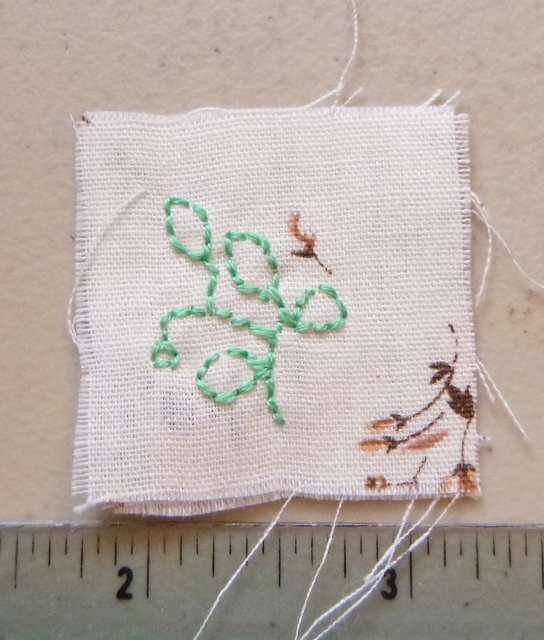
This fabric is also from the estate sale stash. I doubled the fabric so I am sewing through two layers. This was once part of a curtain. While not sheer, the fabric is loosely woven. The fabric frays easily. I do not think it is cotton. I have not fire tested the fabric. The brown print along the edge is outside the 1/4-inch (0.6-cm) seam allowance. The embroidered pattern is not centered. I will wait until it is sewn into rows to add any more sewing.

Day5_cropped (544x640)

This 1.5 inch (3.8 cm) postage stamp square was originally a scrap of curtain. The fabric is loosely woven. I doubled the fabric so to sew through two layers of fabric. The free-hand embroidery is DMC floss.


Here is Day Six’s Postage Stamp Piece No. 6

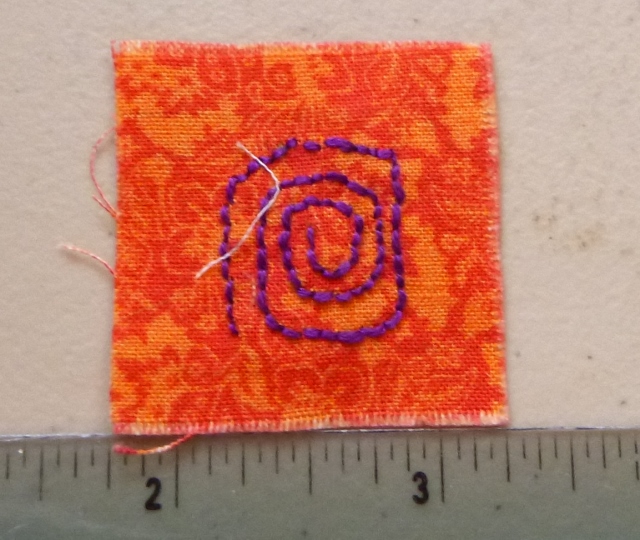
I like the contrast of the purple embroidery floss and the orange fabric.

Day6_cropped (640x540)

This 1.5-inch (3.8-cm) postage stamp square is 100% cotton with a free-hand pattern of purple DMC embroidered floss.


Here is Day Seven’s Postage Stamp Piece No. 7

I like bright and bold colors. I also like color contrasts. The gold-yellow contrasts well with the dark green cotton fabric. This is my favorite so far.

Day7_cropped (640x480)

This 1.5-inch (3.8-cm) postage stamp square is 100% cotton. The free-hand embroidered pattern is DMC floss.


First Row of Postage Stamp Squares

The postage stamp squares are hand sewn into rows of six squares, with a larger square of five rows to follow. There will be 30 squares to for a larger quilt block. Day 4’s No. 4 square unsuccessful effort will be blended into the larger quilt square. Each square, when sewn, is 1 inch (2.54 cm) wide. You can see in No. 2’s blue square the outer triangle’s bottom corners were caught in the seam fold. Placement of the embroidered object will be something to think about as I proceed.

Row1_cropped (640x437)

The first row of the first week of postage stamp squares.

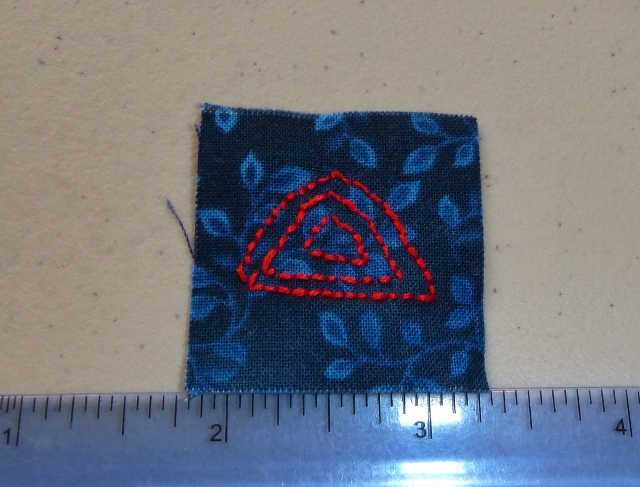
‘Artistic Archetype’ Blog 28-Day Challenge: Day Three— Postage Stamp Block No. 3

Today I went with a light neutral color and a dark red DMC embroidery floss.

I kept the free-hand embroidery centered.

I learned an important lesson with the blue square with red DMC floss. I stayed away from the seam line, but allowed enough space for the seam fold. This block will not have that problem I encountered in Piece No. 2.

Here is Day Three: Postage Stamp Piece No. 3

Day3_PostageStampChallenge small

1.5 inch (3.8 cm) square of 100% cotton fabric with dark red DMC embroidery floss while maintaining 1/4 inch (0.6 cm) seam allowance.


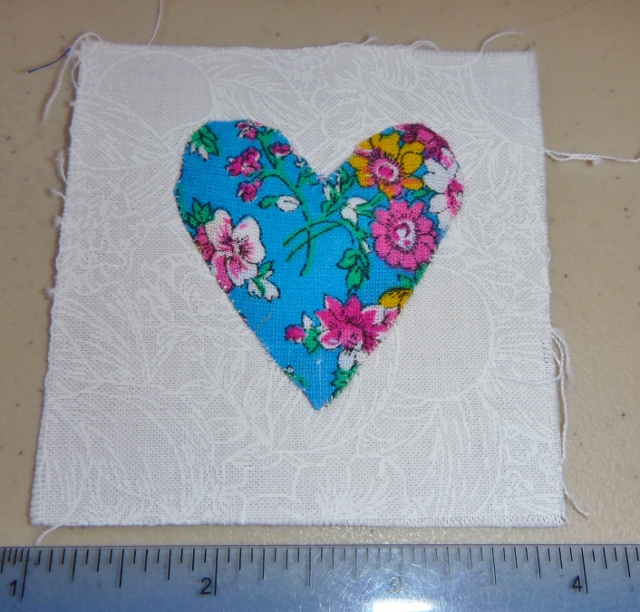
I also wanted to include the heart block I finished on Day 2.

P1050144 (640x612)

3-inch heart block allows a 1/4 inch (0.6 cm) seam. Finished block will be 2.5 inches square. White pattern fabric is leftover from another project. The blue floral fabric is from a scrap in the stash made up of fabric from several estate sales.

‘Artistic Archetype’ Blog 28-Day Challenge: Day Two— Postage Stamp Block No. 2

I started to research the origins of the Postage Stamp Quilt. I found it interesting that up until the widespread production of calico fabric, quilting was within the sphere of the wealthy. Regular people could not afford the fabric to make blankets. In the mid-19th century quilting became popular in the United States with the widespread US production of calico fabric and expansion of a Middle Class.

Today’s 1.5-inch (3.8-cm) square has a problem that I did not realize until I sewed it to the Day One square. The outer red triangle is to big and runs right against the seam allowance. When sewn the bottom tips of the triangle are hidden in the seam. I should have used two triangles instead of three. I was attempting to “fill the canvas” as my grade school art teacher was always telling me. To best utilize the colors of the fabric and embroidery floss, I need to allow for the seam fold.

Here is Day Two: Postage Stamp Piece No. 2

Day2_PostageStampChallenge

1.5 inch (3.8 cm) square of 100% cotton fabric with red DMC embroidery floss while maintaining 1/4 inch (0.6 cm) seam allowance.


‘Artistic Archetype’ Blog 28-Day Challenge: Day One — Postage Stamp Block No. 1

At the first part of January every year there are self challenges one can do. One I admired but thought looked like a recipe for an unfinished project (UFO) was the temperature afghan. Every day you crochet a row with a color you designated as the color for the daily high temperature. This looks like a colorful project that requires daily effort, which is fine. It looked like something I might get bored with say, early March.

I enjoy piecing quilts. I found an alternative idea of making a small, daily quilt square. I like this idea. I found 3-inch squares of neutral colored material in my fabric and scrap stash, and thought I could applique hearts. Each 2-inch heart would be a unique shape and fabric. So, I started, and they look darling. Problem is it takes me two days to baste and applique a heart. Not a square-a-day type project.

I have completed a postage stamp quilt project. I know what I am getting myself into. I made a 16 inch by 16 inch postage stamp quilt block as a wall hanging for a local weaver’s guild challenge. The finished product was to be a certain color combination. I do not weave but I drive my mother to guild meetings and events.  The quilt block was exhibited at an art gallery in St. Francis, Kansas with the weaving guild’s members’ works.

Postage stamp quilt fabric squares are, when finished, 1-inch (2.54-cm) square. When working with pieces of that size, accuracy or lack of precision in cutting the fabric will make or destroy, respectively, your quilting effort. All mistakes are amplified.

After wringing my hands, and hemming and hawing for several weeks, I decided to do the postage stamp a day. I could embroidery the 1-inch square to add interest. Then, I found a blog workshop/essay that challenged the would-be blogger to blog every day as an archetype that matches your personality. I answered several questions and was identified as an “Art blogger”. The postage stamp quilt piece a day merged with a daily “Art blogger” entry. I have several ongoing projects but they are not “finish in a day” projects. As they are completed over the next 28 days I will post pictures of them, too. I will still post recipe reviews and there is a handful of poetry books by women stacked beside my desk I need to review.

Here is Day One: Postage Stamp Piece No. 1

1.5 inch tan square with green emboidry

1.5 inch (3.8 cm), unfinished, tan, 100% cotton square with a freehand design of DMC green embroidery floss while maintaining a 1/4 inch (0.6 cm) seam allowance.

Recipe Review: Classic Challah — King Arthur Flour January #bakealong

classic challah bread #bakealong

Classic Challah bread. This is a three-braid loaf. The golden brown color can be attributed to including honey as an ingredient and the egg wash applied before baking.

“I could live on challah bread, the Jewish kosher bread, quite happily.” Dan Aykroyd


Classic Challah

I first was introduced to Challah (pronounced Hah’-lah) bread when I moved to Columbia, Missouri in early 2001. Uprise Bakery, then located in a basement underneath a shoe store, on certain days baked, if I recall correctly, Challah bread. The Challah bread from Uprise Bakery was an egg bread that dried out quickly. I could not eat a loaf on my own before it dried out and was only fit for the foxes living down on Hinkson Creek to gnaw on.

Two Challah loaves on the Jewish Shabbat table commemorate manna falling from heaven when the Israelites wandered the desert after the Exodus. The manna fell a double portion the day before Sabbath or a holiday. Depending on the source describing the Jewish tradition, Challah is used and treated differently in religious rituals. A small portion of the dough, or baked bread, is set aside as a representative Temple offering. Challah can refer the act of separating the offering before the dough is braided. Ingredients can also be determined by religious tenets. The Shabbat and Jewish holiday meals start with two whole loaves, or twelve loaves, of kosher bread. By braiding six strands, the two loaves could represent twelve loaves. I would recommend you research Challah bread and discover its role in Jewish rituals for yourself.

King Arthur Flour Classic Challah bread recipe came together with ease. I had all the ingredients in the pantry. I weighed the dry and wet ingredients in grams. I used canola oil as the vegetable oil. While everything worked well this time, next time I make this recipe I will bring the eggs to room temperature before adding and mixing. Mixing 115 F (46 C) water and cold eggs made me nervous. One package of instant yeast did not quite fill a tablespoon, but I used only the one package. I combined the ingredients in the order listed. Using a stand mixer, the dough mixed and then kneaded with a dough hook for eight minutes. I then consulted the family baker, my father, who agreed with me the dough was much to wet. I was expecting a wet dough because of the eggs. Some sweet bread dough is a wet dough, but this was beyond expectation.
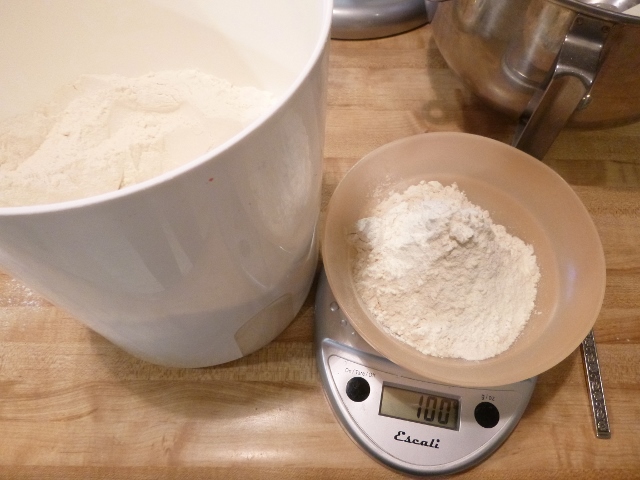
weighing flour in grams

I weighed the dry and wet ingredients in grams.

There is something called the Baker’s Ratio or Baker’s Percentage. All good bread recipes follow this “magic” or “golden” ratio: 5 parts flour: 3 parts liquid. It does not matter if the bread is dinner rolls made with real, melted European butter or pizza dough made with cheap olive oil, both follow this ratio. Same flour, salt, and yeast, different tasting oils. The Baker’s Percentage is a ratio that determines how much of any ingredient needs to be present in proportion to the weight of flour. Egg or sweet breads tend to be on the wet side, violating the Baker’s Percentage because the eggs provide more liquid. For this recipe I did not weigh the eggs. I did not think to weigh the eggs. Next time I use eggs I will weigh the eggs. This Challah recipe also calls for 85 g honey. Honey is also a liquid, so you need to account for that weight in the 3 parts liquid. I calculated with the called-for 482 g flour, you would be permitted 337 g liquid. This Challah recipe’s 113 g water + 74 g vegetable oil + 85 g equals 272 g total liquid. This allows an additional 65 g for two liquid eggs. Two local farm-raised winter eggs should weigh, without shell, about 95 g. This would produce a wet dough.

challah dough after 8 minutes of kneading

I mixed the ingredients in the amounts called for by the recipe. After 8 minutes of kneading by the stand mixer I stopped to assess the situation. The dough is too wet.

A tablespoon of flour, each weighing 10 grams, was added at a time to the mixing dough for a total of 4 tablespoons, or 40 grams, before the dough looked and felt right. Under the Baker’s Percentage, the flour addition brought the weight of flour to 522 g and the estimated liquid weight to 365 g. The stand mixer kneaded for an additional 4 minutes.

dough with additional 40 g flour

After the addition of 40 g flour and four minutes of additional kneading, the dough was fine.

The dough was allowed to raise in a greased bowl on top of the refrigerator for 2 1/2 hours.

Challah dough and English muffin dough at the end of their first raise.

Challah dough (on your right) at end of the first raise on top of the refrigerator. Next to Challah dough is English muffin dough.

Working on a greased kneading mat, I weighed out three balls of dough, each weighing 306 grams. I used no flour when I worked the dough. I watched the King Arthur Four braiding demonstration video while the dough balls rested. Each ball was hand-rolled into a shorter than 20-in (51-cm) rope which shrank back every time I lifted my hands. The ropes rested on the greased kneading mat covered with greased wax paper for 10 minutes. The ropes did not shrink after resting, and stayed 20 in (51 cm) long. The three-braid loaf seemed most appropriate for a simple evening soup dinner. The loaf braided easy. I placed the loaf on a parchment paper covered silicon baking mat covering a heavy baking pan.

braiding of challah bread

Braiding a three-braid Challah loaf. I used a greased surface and did not add any more flour when working with the dough.
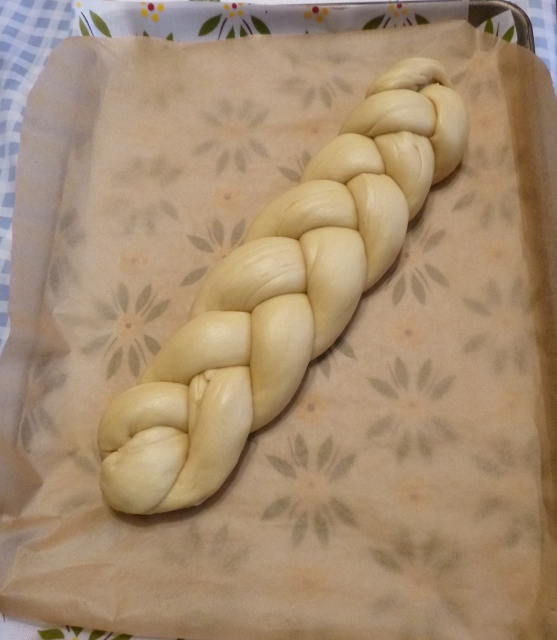
braided Challah loaf before raise

The three-braid Challah loaf on a heavy baking sheet with a silicon baking mat and parchment paper before raising.

Challah loaf after raising

After raising for 2 1/2 hours, the three-braid Challah loaf is ready for an egg-water wash before being placed in a 375 F (190.5 C) oven.

I covered the loaf with a greased wax paper. The braided loaf raised for 2 1/2 hours on top of the refrigerator. I brushed the egg-water glaze over the entire loaf. I set the heavy baking sheet onto a larger heavy baking sheet as directed by the recipe in order to prevent the loaf bottom from over browning or scorching. The loaf baked at 375 F (190.5 C) for 20 minutes. I rotated the loaf at 20 minutes for even baking in the oven.

Challah loaft baked for 20 minutes

The three-braid Challah loaf has baked for 20 minutes.

I placed a piece of tented aluminum foil over the loaf. The loaf was baked in the oven for another 13 minutes.

classic challah bread #bakealong

Classic Challah bread. This is a three-braid loaf. The golden brown color can be attributed to including honey as an ingredient and the egg wash applied before baking.

At the end of the 13 minutes the internal temperature of the bread was 200 F. The 13 minutes may have been to long to continue baking. Because of all the heat escaping when I turned the baking sheet, I was concerned with not allowing the bread enough time undisturbed in a hot oven. The aluminum foil slowed the browning, but did not completely stop  browning. You will want to watch and monitor the bread towards the end of baking time so that it does not scorch.
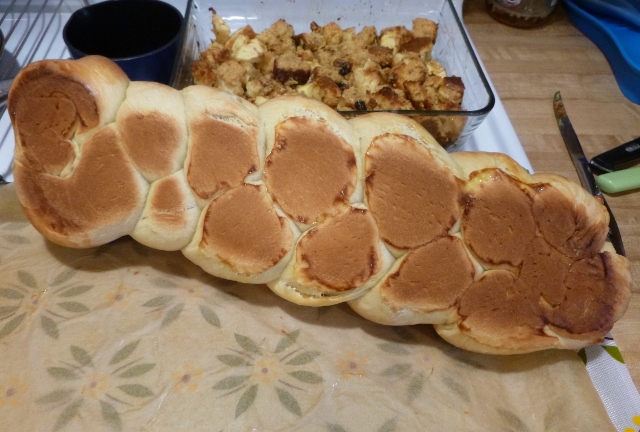
bottom of Challah loaf

The bottom of the Challah loaf.

This bread went very well with the Cajun-spiced soup. You can get 16 servings from the bread. I took 1/3 of the loaf, sliced, to work on Monday. The Challah loaf was enjoyed by all. The texture, color, and taste was an enjoyable change from the whole wheat or sourdough breads my family usually makes. I am glad I now have Challah bread within my repertoire.

There are different ways to approach the ritual meaning or what Challah bread represents inside Jewish culture. I suggest you read and contemplate for yourself.

Wikipedia is a good introduction to Challah bread and its use in religious life. Challah

Another source of Challah bread information.  https://headcoverings-by-devorah.com/Challah.html

Here is another source of information: https://www.myjewishlearning.com/article/challah/

I would be remiss if I did not include the Uprise Bakery website. They moved to a building they share with Ragtag Cinema and 9th Street Video on Hitt Street next to the Presbyterian Church. http://www.uprisebakery.com/

A website that explains the Baker’s Percentage is here: https://bread-magazine.com/master-formula/